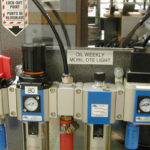
Consider the following safety and design choices for control of pneumatic systems in automated equipment. By Pat Phillips • Product Manager, Fluid Power & Mechanical Products at AutomationDirect A safe pneumatic system design starts at the connection to a machine’s air preparation hardware and continues to correctly pairing valves with cylinders. This article reviews the […]
Engineering Basics
How important are storage receivers to my screw compressor?

If you have one or more lubricated screw compressors that run partially loaded in load/unload mode, the size of the storage receiver is quite important to the compressor operating efficiency—and may affect its lifespan. If your compressors run in modulation mode, the least efficient way to run a screw compressor, the compressor efficiency is likely […]
What type of compressor should I use for my industrial site?

There are many choices to consider when looking to buy a new compressor for your industrial plant. The most common choices are reciprocating compressors, screw compressors, and centrifugal compressors. The best choice depends on the size of your facility and how you use compressed air. If you have a very light compressed air load—and don’t […]
How are pneumatic actuators used in automation applications?

Pneumatic actuators come in an array of permutations for automation. Rod and rodless actuators are the two most common, though rodless are far more common in the U.S. Rodless actuators include bearings to address moment loads in X. Y, and Z. Tip: Avoid undersized pneumatic actuators for applications by accurately calculating application force; subtracting piston-rod […]
What are single-point lubricators?

Single-point lubricators provide consistent delivery of the exact amount of oil required for pneumatically driven tools. Tools that run off of pneumatic power — such as handheld power tools, screw drivers, nut runners and more — operate best when they consistently receive the correct amount of oil. Too much oil can puddle in low points […]
Compressed air fail: Water hammer

By Ron Marshall for the Compressed Air Challenge A building products company chose to allow their piping contractor to design the piping system in their compressor room. Rather than coming off the top of the wet header in the compressor room, the compressors were connected to the bottom of the run. This was much simpler […]
What are air dryers?

In pneumatic systems, compressors draw in ambient air that always contains some amount of water vapor. The process of compressing air to around 100 psi raises the air’s temperature, but also dew point and water-holding capacity. Any subsequent cooling downstream will likely cause some water vapor to condense. Liquid water in pneumatic systems creates problems […]
Where are pneumatic grippers used?
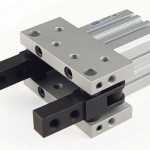
Pneumatic grippers are used in many pneumatic systems, as a means of grasping or holding parts; grippers may move, insert, stack or orient the parts to achieve a desired step in a manufacturing process. Grippers, which use compressed air to actuate the jaws, come in multiple styles, including parallel and angular, and may use a […]
Can water damage my compressed air system?

In a previous post, we discovered that air compressors will produce significant amounts of water, which is squeezed from the ambient air the compressor ingests through its intake. This water, if left in the system, can damage the air compressor and components connected to your compressed air system and possibly contaminate your product. Piping will […]
Why is there water in my compressed air system?

Depending on inlet conditions, air compressors can produce lots of water. If this water is not removed, it can travel through your piping and overwhelm your air dryer (if you have one). The water will rust steel pipes, and act as a solvent for compressor lubricant. The water picks up the rust, oil, and dirt […]
