
• Skip to primary navigation
  • Skip to main content
  • Skip to primary sidebar
  • Skip to footer
  • Advertise
  • Subscribe

Pneumatic Tips

Tips, Trends, Resources, News and Information

  • Blog
  • Industry News
  • Air Preparation
  • Engineering Basics
  • Components
    • Actuators
    • Cylinders
    • Fittings
    • Gears
    • Grippers
    • Pumps
    • Air Compressors
    • Tubing
    • Vacuums
    • Valves
  • Pressure Sensing
  • Design Guide Library
  • Classrooms
    • Pneumatics Classroom
You are here: Home / Air Preparation / What are single-point lubricators?

What are single-point lubricators?

December 12, 2016 By Mary Gannon

Share
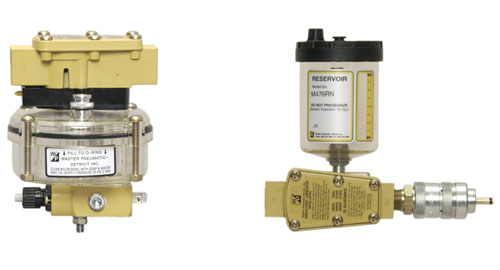
MasterPneumatic Single Point Lubricators
Single point lubricators deliver exact amounts of oil to downstream tools. Here are designs with integral 10 oz reservoirs and pulse counter with 1/2 or 3/4 in. NPTF Female ports (BSPP optional). Image courtesy of Master Pneumatic

Single-point lubricators provide consistent delivery of the exact amount of oil required for pneumatically driven tools. Tools that run off of pneumatic power — such as handheld power tools, screw drivers, nut runners and more — operate best when they consistently receive the correct amount of oil. Too much oil can puddle in low points and coalesce on air-line walls. This oil can also be released to atmosphere, which can be inhaled by personnel or cause falls by creating slick surfaces. Too little oil results in tools that don’t perform as they should, which can result in shorter life cycles and costly downtime.

Conventional-mist-lubricator-web
Image courtesy of Master Pneumatic

While mist lubrication can be used, targeted single-point lubricators (SPLs) deliver the oil directly to the point of use, which in turn eliminates the over- and under-lubrication problems with air-powered tools. They can be installed vertically or horizontally.

Every time the tool is cycled, oil is delivered via an internal, 6-in. oil capillary tube before the tool in a fine, consistent state rather than in a slug periodically. The volume of oil can be set at 0.016, 0.033 and 0.066 cc, and can be delivered every five or 10 cycles of the tool. Engineered coaxial fittings and disconnects ensure the simultaneous delivery of air and oil from the SPL to the tool. This minimizes oil usage; reduces excess oil mist in the tool exhaust (which can end up on the employee or the product being manufactured); reduces power tool maintenance and downtime; increases tool performance and life.

Lubricator-operation-web
Image courtesy of Master Pneumatic

Single point lubricators were developed for the auto industry, which required a small amount of oil to air motors or multiple spindle nut runners to ensure torque consistency. The application was a success and also resulted in increasing the air motor’s life and decreased repair costs.

Single point lubricators use a positive displacement pump that puts out a very small amount of lubrication for exact and precise lubrication. They’re highly adjustable and absolutely repeatable. Users can dial in just the amount of fluid required. They don’t depend on air pressure or flow.

Filed Under: Air Preparation, Engineering Basics, Featured Tagged With: masterpneumatic

Primary Sidebar

Fluid Power World Digital Edition

Fluid Power World Digital EditionBrowse the most current issue of Fluid Power World and back issues in an easy to use high quality format. Bookmark, share and interact with the leading design engineering magazine today.

RSS Featured White Papers

  • eBook: Practical Guide to Pneumatics
  • Saving energy and service cost with electric linear systems
  • White Paper-How to Design Efficient Pneumatic Systems!

Fluid Power Design Guides

fluid
“pt
EXPAND YOUR KNOWLEDGE AND STAY CONNECTED
Get the latest info on technologies, tools and strategies for Fluid Power Professionals.
Hose Assembly Tips

Footer

Pneumatic Tips

Fluid Power World Network

  • Fluid Power World
  • Hose Assembly Tips
  • Mobile Hydraulic Tips
  • Sealing and Contamination Tips
  • Fluid Power Distributor Lookup

PNEUMATIC TIPS

  • Subscribe to our newsletter
  • Advertise with us
  • Contact us
  • About us

Copyright © 2026 · WTWH Media LLC and its licensors. All rights reserved.
The material on this site may not be reproduced, distributed, transmitted, cached or otherwise used, except with the prior written permission of WTWH Media.

Privacy Policy