

In a preview of their offerings at this year’s digital Hannover Fair, scheduled for April 12 to 16, Emerson takes a pragmatic look at today’s IoT landscape and discusses a number of new edge computing and analytics products that help manufacturers turn data into actionable insights.

“We are 30 years into the concept of ‘big data’ yet still see massive shortfalls in the industry’s ability to capture insights and create meaningful impact,” said Dr. Michael Britzger, senior manager, IIoT Engineering & Innovation at Emerson. Projects involving big data are typically complex — often involving petabytes of data — and demand a lot of resources, are expensive to implement, and require a long-term commitment, he said. According to consulting firm Gartner, an estimated 85% of big data projects fail globally because organizations continually move too ambitiously to collect data without a full plan to understand or use it.
A better approach for most companies is harnessing ‘little data’ said Britzger. “Little data starts directly at the edge of your machine. It addresses known problems, enables entry to the world of IIoT and provides rapid integration into local solutions. Little data is collected at the “edge” of machines using local industrial PCs. “That enables optimization to start directly at the source — faster than ever,” he said.
Emerson’s goal is to help customers improve overall equipment effectiveness, he continued. With the little data approach, we can predict failures, improve the throughput of machines, avoid downtime and monitor the health of specific devices. And by detecting air leaks in a system, reducing losses and waste, this optimizes energy consumption and improves the efficiency and sustainability of a machine.
“However, Emerson is aware that the most important tasks in respect to IoT applications are connectivity, flexibility and security. With open data exchange, applying standard protocols such as OPC UA or MQTT, we provide a connection from the lower level up to any higher hierarchy within the system. We are aware of the need for future-proof scalability and ensure secure-by-design applications, to be sure from the very beginning we have security,” he said.
“With all than in mind, Emerson has now developed an integrated edge platform called PACEdge 2.0 to turn machine data into actionable insights with the most advanced technology available.” PACEdge is a tool set that provides simplified development and deployment, and it ensures open connectivity with other systems or devices, Britzger explained. PACEdge connects at the device level with PLCs, drives, pneumatic valve stacks, and sensors, aggregates the data to create insights and analytics, and connects to operational technology such as a SCADA system or a customer MES system.
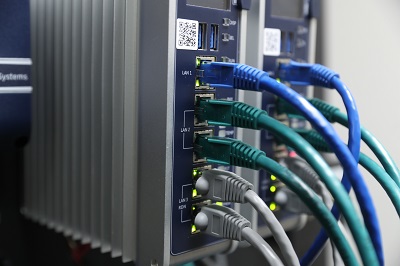
“So Emerson is, in a sense, a one-solution partner, starting with a data source such as an air flow sensor, which connects via OPC to the PACEdge gateway, where the data is aggregated and analyzed, and then visualized via an industrial PC. With that, we provide advanced analytics to our customers and specific solutions — for example, monitoring pressure, position, cylinder cycle time, energy usage, life-cycle management, or air leakage detection.”
“PACEdge 2.0 brings together leading, open-source applications into a powerful and scalable IIoT platform for the modern factory,” said Britzger.
Examples of the new offerings include:
AVENTICS Series AF2 flow sensors monitor air consumption in pneumatic systems. The data they collect helps detect leaks faster, optimize energy consumption, prevent machine downtime and cut costs.
AVENTICS Series SPA Smart Pneumatics Analyzer monitors and visualizes pneumatic installations and systems. Using mathematical algorithms, the SPA digitizes and translates sensor data into information that helps improve overall equipment effectiveness.
AVENTICS fieldbus electronics and I/O technology simplifies communications and connectivity between controls, valve systems and sensors with a wide range of relevant protocols, including I/O-Link. They are readily configurable to meet modularity and plug-and-play requirements, ensuring straightforward installation. The integrated Series G3 graphic display provides direct, easy-to-understand diagnostics, and simplified commissioning.
PACEdge IIoT Software for edge analytics provides developers with an integrated and secure platform for creating, deploying and scaling applications, ensuring a single source across IT, OT and enterprise-level data, letting any end user derive valuable insights.
PACSystems RXi2 Edge Computers offer rugged designs for the industrial world, and high-performance analytics and graphics with maximum flexibility for a wide range of applications.
PACSystems RX3i CPL410 Edge Controller provides true edge control technology, combining real-time, deterministic control with advanced, Linux-based applications in a single device. It serves as a foundation for industrial IOT. The RX3i uses the powerful PACSystems control engine and programming environment for application portability across all Emerson PLC hardware.
Movicon.NexT HMI/SCADA is an industrial software platform that provides plant analytics, industrial visualization, human machine interface and supervisory control and data acquisition to drive better and smarter insights for digital transformation. The flexible, scalable software platform is available for both Windows and Linux using the latest technologies that are essential to Industry 4.0.
Emerson
www.emerson.com
Hannover Messe
www.hannovermesse.de

Leave a Reply