• Skip to primary navigation
  • Skip to main content
  • Skip to primary sidebar
  • Skip to footer
  • Advertise
  • Subscribe

Pneumatic Tips

Tips, Trends, Resources, News and Information

  • Blog
  • Industry News
  • Air Preparation
  • Engineering Basics
  • Components
    • Actuators
    • Cylinders
    • Fittings
    • Gears
    • Grippers
    • Pumps
    • Air Compressors
    • Tubing
    • Vacuums
    • Valves
  • Pressure Sensing
  • Design Guide Library
  • Classrooms
    • Pneumatics Classroom
You are here: Home / Air Preparation / Compressed air fail: Regulator size

Compressed air fail: Regulator size

February 4, 2022 By Paul Heney

Share

An industrial component manufacturer had a system of five compressors located in an interconnected system spread between two buildings. The system pressure of the system was constantly running near 120 psi because of some critical high-pressure applications. Most of the production machinery was rated at 90 psi pressure.

The facility manager was sure something could be done and called in a compressed air professional to study the system.  The expert did a thorough machine-by-machine inspection and found only two applications required the higher-than-normal pressure.

Inside the machine, he discovered, were undersized components. A filter and regulator assembly, rated for only 25 cfm, was passing higher than rated flows during short duration peak demands inside the machine.  This overloaded ¼-in. regulator had excessive pressure drop during these peaks (Figure 1), causing the machine to go down if the compressors weren’t set to deliver 120 psi compressed air.
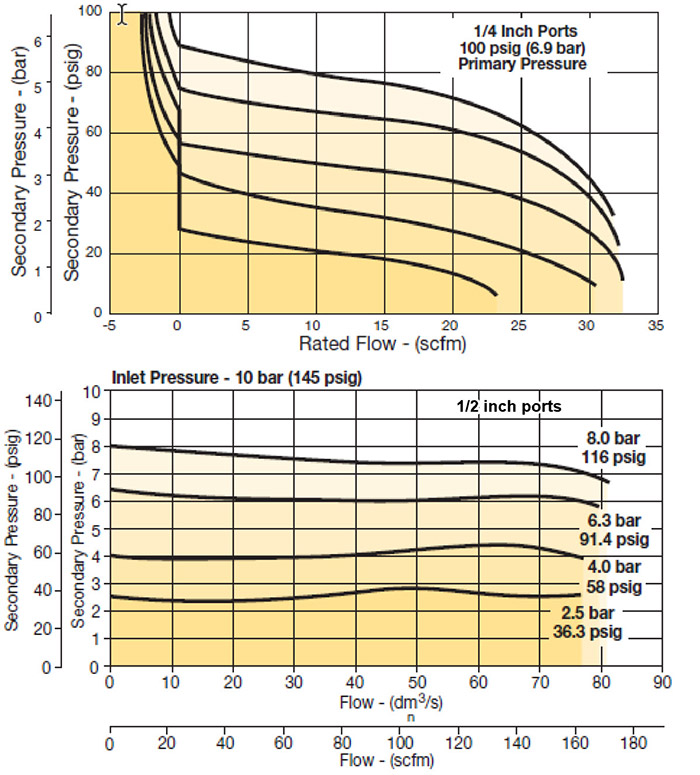
Figure 1. The ¼-in. regulator curve (upper chart) shows significant pressure droop at higher flows. Replacing it with a ½-in. regulator reduced the pressure loss and allowed the plant compressor discharge pressure to be reduced, saving power.

The expert worked with the manufacturer to find a suitable precision ½-in. regulator for the job, once installed the compressor discharge pressure was turned down to 100 psi.  At this level the air compressors consumed about 10% less energy, and as a secondary benefit the plant consumed about 5% less flow due to the lower pressure. Total savings in resizing the regulator $28,000, considerably more than the cost of the correctly sized components.


You may also like:


  • Compressed air fail: Dryer spitting ice?

  • Compressed air fail: Blowoff

  • Compressed air fail: Modulation lesson

  • Compressed air fail: Ventilation

Filed Under: Air Compressors, Air Preparation

Primary Sidebar

Fluid Power World Digital Edition

Fluid Power World Digital EditionBrowse the most current issue of Fluid Power World and back issues in an easy to use high quality format. Bookmark, share and interact with the leading design engineering magazine today.

RSS Featured White Papers

  • eBook: Practical Guide to Pneumatics
  • Saving energy and service cost with electric linear systems
  • White Paper-How to Design Efficient Pneumatic Systems!

Fluid Power Design Guides

fluid
“pt
EXPAND YOUR KNOWLEDGE AND STAY CONNECTED
Get the latest info on technologies, tools and strategies for Fluid Power Professionals.
Hose Assembly Tips

Footer

Pneumatic Tips

Fluid Power World Network

  • Fluid Power World
  • Hose Assembly Tips
  • Mobile Hydraulic Tips
  • Sealing and Contamination Tips
  • Fluid Power Distributor Lookup

PNEUMATIC TIPS

  • Subscribe to our newsletter
  • Advertise with us
  • Contact us
  • About us

Copyright © 2026 · WTWH Media LLC and its licensors. All rights reserved.
The material on this site may not be reproduced, distributed, transmitted, cached or otherwise used, except with the prior written permission of WTWH Media.

Privacy Policy