

By Josh Cosford, Contributing Editor
Vacuum technology is the quintessential method for safe and careful material handling in various industries, from packaging to glass manufacturing. Vacuum cups and pads are gentle and soft, lifting even the largest material while barely contacting the surface. By creating a vacuum inside the cup, the pressure differential draws the material towards the cup. With attraction force factored by both the area of the cup and the pressure differential, even minimal vacuum force is required to hold a fair-sized load, especially when many cups are added to the job.
We commonly use two methods to create a vacuum: generators and pumps. The terms are misleading since pumps also generate a vacuum. Nevertheless, how each option uses technology to create a vacuum comes through vastly different methods. The vacuum generator uses the venturi vacuum system as defined by Bernoulli’s Principle, whereby air blown through the generator creates a low-pressure area and subsequent suction. The downside to vacuum generators is their requirement for continuously flowing air during the gripping phase of their operation.
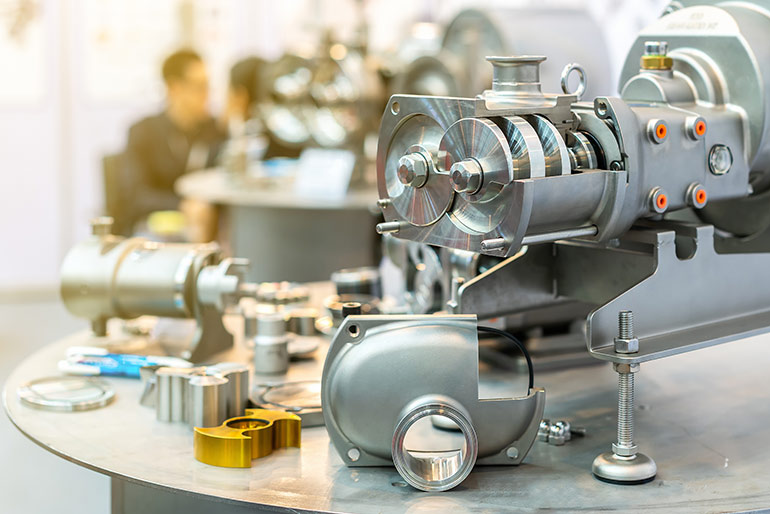
Vacuum pumps, on the other hand, create differential pressure by pumping air from a vessel, much like a compressor. Vacuum pumps used to pull air molecules out of a vacuum chamber are often positive-displacement types, such as rotary vane pumps, scroll or screw pumps. Although rarer than vacuum generators, centralized vacuum systems make material handling easy and efficient, mainly when such a system already exists in a factory for conveying raw materials, such as plastic pellets for injection molding.
Positive displacement vacuum pumps are offered in both dry and wet options. The wet type uses oil lubrication, which offers superior longevity and lower maintenance. The oil in the pump’s crankcase lubricates the major moving components and bearings and is generally a bit quieter than dry pumps. However, in cases where oil or its vapor may contaminate downstream material such as food goods or microprocessors, a dry style pump should be selected, and air dryers added to the system. However, a dry pump may require greasing or oiling of bearings, gears or bushings, so be mindful of maintenance requirements when selecting your pump.
Although solenoid valves are used to turn vacuum generators on and off, systems with central vacuum pumps still need valves to open and close the vacuum path at the suction cups. A single valve may activate a single cup or bank of cups, depending on the material handling requirements. Highly versatile beds with a single valve per cup can use sophisticated vision systems to actuate only the suction cups required when handling various items or those with complicated shapes. The efficiency advantage lies with the vacuum pump circuit since only leakage flow requires replenishment from the pump during handling.
Whether for bulk material transfer, material handling or basic vacuum technology, a vacuum pump offers the most efficient method of creating pressure differential we observe as vacuum. Many manufacturers offer compact all-in-one units for low-duty use. At the same time, other system integrators can design, build and install central vacuum systems for even the largest factory.





Leave a Reply