
By Ron Marshall, Contributing Editor
Fred had been the plant engineer at the packaging facility for nearly ten years, and he thought he understood his compressed air system well. The compressors ran, the machines worked most of the time, and whenever there was a moisture problem someone usually changed a filter or drained a receiver tank. But lately things were getting worse.
Pneumatic cylinders were sticking. Solenoid valves were failing early. Operators complained about inconsistent machine operation during colder weather. One morning Fred even found a rusty brown liquid dripping from an air line feeding a critical packaging machine. “That can’t be good,” he thought.
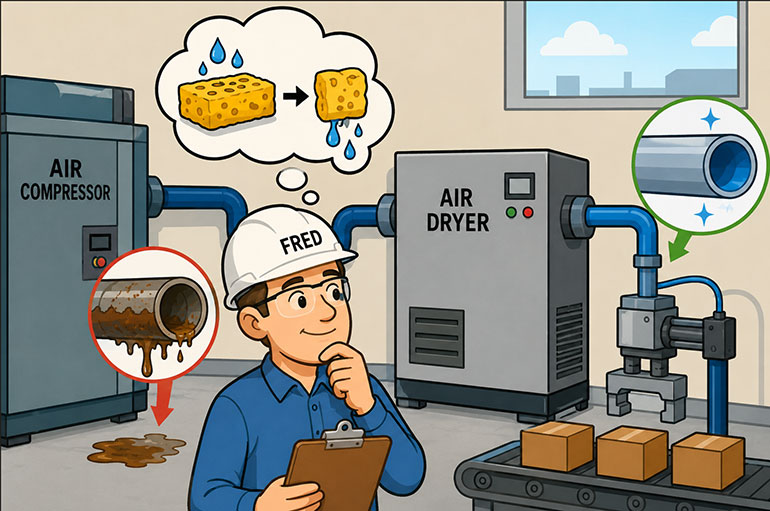
During a Compressed Air Challenge training seminar, Fred finally learned what was really happening inside his system. The instructor explained that air behaves much like a sponge. Warm atmospheric air naturally absorbs moisture. When an air compressor squeezes that air, the moisture must go somewhere. As the compressed air cools downstream, water condenses inside the piping system.
And that water does not travel alone. It mixes with dust, pipe scale, rust particles and compressor lubricant residue to form a dirty soup that can contaminate equipment throughout the plant. Suddenly, Fred understood why his maintenance team kept fighting the same problems over and over again.
The seminar explained that compressed air dryers are designed to remove moisture before it reaches production equipment. Fred learned there are two common types of dryers used in industry.
The first was the refrigerated dryer already installed in his plant. These dryers cool compressed air close to the freezing point of water so moisture condenses and can be removed. They typically produce dew points around 35° to 40° F, which is acceptable for many industrial applications.
The second type was the desiccant dryer. These systems use special moisture-absorbing material to strip water vapor from the air stream and can produce extremely dry air with dew points as low as –40° F. Fred learned these were often used in plants where moisture could ruin products or freeze in outdoor piping.
But what really caught Fred’s attention was the energy discussion. The instructor explained that most dryers consume nearly full power even when the plant is operating at very low demand. Because dryers are usually sized for the hottest and most humid day of the year, they spend much of their life oversized for actual operating conditions.
Fred immediately thought about weekends at his plant, when production slowed but the dryers continued running almost nonstop.
That led him to investigate energy-efficient dryer controls. He learned that cycling refrigerated dryers reduce power consumption during light loads, while advanced desiccant dryers use dew point controls or moisture sensors to avoid unnecessary regeneration cycles.
After reviewing his system, Fred discovered his old non-cycling dryer was operating inefficiently for thousands of hours every year. By upgrading controls and reducing pressure differential across fouled filters, the plant significantly reduced wasted energy while improving air quality and reliability.
For Fred, the biggest lesson was simple: compressed air drying is not just about removing water. It is about protecting equipment, maintaining product quality, reducing maintenance headaches, and controlling operating costs. And once again, the compressed air system proved something Fred was learning more every year — the real savings are often hidden in the details nobody notices.
