

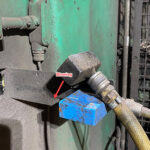
 A metal products manufacturer had a production problem in one of its processing areas. The maintenance staff had increased the discharge pressure on their air compressors to help with the issue, but it seemed the problem would come back occasionally with no warning. Fig. 1 shows the problematic item, a vacuum pick-up crane. When the air pressure goes down, the vacuum force is not enough to maintain pick-up force — then the heavy metal items drop on the operator’s toes. Not an ideal situation!!
The compressor operators noted that the issue disappeared if they always kept their compressor discharge pressure higher than 95 psi. So, to avoid problems, they ran their system at 115 psi, just to be safe. No other item in the plant needed 95 psi; this one end use was pushing up the required plant pressure. A compressed air auditor working on the system estimated the extra pressure required was costing about $14,000 per year in extra compressor energy, because compressors consume about 1% more power for each 2-psi increase.
The pick-up operation consumed about 20 cfm of compressed air when it operated. The compressed air was consumed by a vortex style vacuum generator mounted on the pick-up rail. The generator was fed with about 10 feet of ¼-in. coiled plastic hose. The auditor pointed out that there was significant pressure loss in this hose and perhaps the pressure limitation may not be 95 psi.
Looking at the chart (Fig. 2) we can see that when the generator operates about 19 psi pressure differential develops across the hose.

If the hose was upgraded to the next larger size, or even bigger, there would be a significant boost in pressure, and a performance increase in the operation. Then the discharge pressure of the compressors could be lowered. In this case a $200 fix could save $14,000 per year in wasted energy costs!
It pays to know your pressure loss on critical equipment.

Leave a Reply