• Skip to primary navigation
  • Skip to main content
  • Skip to primary sidebar
  • Skip to footer
  • Advertise
  • Subscribe

Pneumatic Tips

Tips, Trends, Resources, News and Information

  • Blog
  • Industry News
  • Air Preparation
  • Engineering Basics
  • Components
    • Actuators
    • Cylinders
    • Fittings
    • Gears
    • Grippers
    • Pumps
    • Air Compressors
    • Tubing
    • Vacuums
    • Valves
  • Pressure Sensing
  • Design Guide Library
  • Classrooms
    • Pneumatics Classroom
You are here: Home / Air Preparation / Compressed air fail: Mind the gauges

Compressed air fail: Mind the gauges

September 22, 2020 By Paul Heney

Share
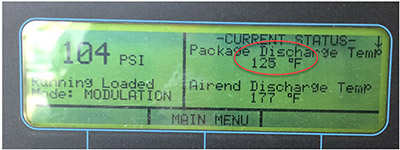
Figure 1. Operational staff did not notice high compressor discharge temperature.

A sawmill had a large compressor located in a small outbuilding near their mill. The compressor was moved away from the plant because there was excessive dust inside. But even in a remote location, the sawdust found its way into the compressor intake — and deposited inside the compressor’s air-cooled aftercooler.  The restriction caused by excess buildup made the discharge temperatures to rise to 125° F and higher.

Because the compressor was installed remotely, it was a bit of a hike to visit it when it was operating at full capacity. Operational staff did not notice the excessive temperatures, and the condition caused an overload of moisture going into the air dryer. Air dryers are normally rated for 100° F inlet temperatures and not designed to handle higher levels.
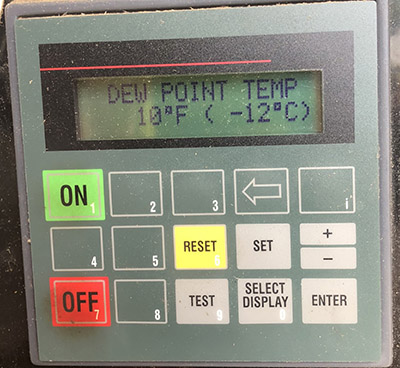
Figure 2. The excessive discharge temperature overloaded the desiccant dryer resulting in poor dew point, normal is -40° F.

Running the dryer intake air at 25° higher than rating more than doubled the amount of water the unit had to process. As a result, the dew point on the dryer showed 10° F rather than the normal rating of -40° F. What was worse, a portable dew point tester was installed on the dryer discharge and measured a dew point of 75° F; the onboard dew point probe had been flooded by excess moisture and had become out of calibration.

The excess dew point and probe failure made the dryer run its heater and blower full time. Rather than turning off on dew point control, the average flow into the dryer was only 25% of its capacity … yet the heaters worked near 100% duty, costing an extra $6,000 per year in electricity costs.

Regularly checking the temperature gauge and then taking action by cleaning out the cooler could have prevented this problem. Additional filtering of the cooling intake air would also help keep the intake free of dust. Repairs are ongoing, with corrections expected to correct air quality and save significant energy.

You may also like:


  • Compressed air fail: Verification spots trouble

  • Compressed air fail: Flow meter trouble

  • Compressed air fail: Dryer clog

  • Compressed air fail: Locked on

Filed Under: Air Preparation

Reader Interactions

Comments

  1. William Ketel says

    September 24, 2020 at 8:28 pm

    Adequate remote monitoring would have caught the problem before it started costing a lot. And a dP monitor on the inlet filter would have seen the problem much sooner. Adequate monitoring of sucjh a critical asset as a main compressor is rather useful.

Primary Sidebar

Fluid Power World Digital Edition

Fluid Power World Digital EditionBrowse the most current issue of Fluid Power World and back issues in an easy to use high quality format. Bookmark, share and interact with the leading design engineering magazine today.

RSS Featured White Papers

  • eBook: Practical Guide to Pneumatics
  • Saving energy and service cost with electric linear systems
  • White Paper-How to Design Efficient Pneumatic Systems!

Fluid Power Design Guides

fluid
“pt
EXPAND YOUR KNOWLEDGE AND STAY CONNECTED
Get the latest info on technologies, tools and strategies for Fluid Power Professionals.
Hose Assembly Tips

Footer

Pneumatic Tips

Fluid Power World Network

  • Fluid Power World
  • Hose Assembly Tips
  • Mobile Hydraulic Tips
  • Sealing and Contamination Tips
  • Fluid Power Distributor Lookup

PNEUMATIC TIPS

  • Subscribe to our newsletter
  • Advertise with us
  • Contact us
  • About us

Copyright © 2025 · WTWH Media LLC and its licensors. All rights reserved.
The material on this site may not be reproduced, distributed, transmitted, cached or otherwise used, except with the prior written permission of WTWH Media.

Privacy Policy