

With theater performances, the illusion of a reality on a stage must be preserved seamlessly and without visual distraction. Safety of the performers, however, must never be an illusion.
The stage lifts at the opera house in Genoa, Italy are equipped with safety locks to prevent movement in the event of power loss. The motion of these lifts, each capable of bearing loads to 100,000 lb, is maintained by hydraulic cylinders equipped with SITEMA safety locks Type KRG. In normal power-on conditions, pressure on the lock’s annular piston ensures free movement of the cylinder rod by holding the clamping sleeve released against the force of an integral Belleville spring assembly.
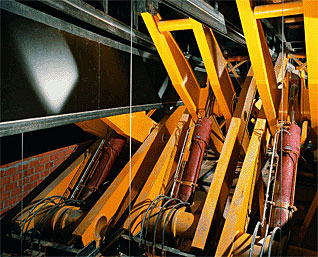
Safety locks were installed with these cylinders at a Italian opera house.
In a released position, that is, upon loss of power to the cylinder, the annular piston keeps the clamping sleeve pushed against the Belleville springs. The spring washers press the clamping sleeve into the taper of the housing, whereby an initial frictional force develops between the rod and the clamping sleeve. When load is applied, the force increases, so the higher the load, the stronger the clamping. In normal applications, the safety locks function best for loads from 2 kN to 500 kN (220 to 110,000 lb).
When the load acts on the rod, the rod movement is very slight. Even in the largest sizes, the movement does not exceed 2 mm (0.079 in.) for the permissible load. Against forces in the load direction, the higher the force the stronger the grip. When power is restored, the upward movement of the rod releases the clamping and a proximity sensor/switch detects the change and permits unimpeded downward motion.
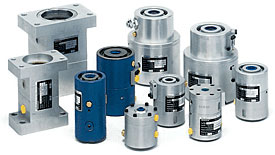
Safety locks ensure that stages stay in place, even through a power loss.
The rod end used for these safety locks must be fitted with a lead-in chamfer and the rod surface should be hardened to at least HRC 52, burnished and within ISO tolerances f7 or h6, with a surface finish Rz=1 to 4mm or Ra 0.15-0.25mm. Hard chrome plating is recommended.
SITEMA
www.sitema.com

Leave a Reply