
• Skip to primary navigation
  • Skip to main content
  • Skip to primary sidebar
  • Skip to footer
  • Advertise
  • Subscribe

Pneumatic Tips

Tips, Trends, Resources, News and Information

  • Blog
  • Industry News
  • Air Preparation
  • Engineering Basics
  • Components
    • Actuators
    • Cylinders
    • Fittings
    • Gears
    • Grippers
    • Pumps
    • Air Compressors
    • Tubing
    • Vacuums
    • Valves
  • Pressure Sensing
  • Design Guide Library
  • Classrooms
    • Pneumatics Classroom
You are here: Home / Air Preparation / Matching compressed air capacity with controllers

Matching compressed air capacity with controllers

September 14, 2021 By Paul Heney

Share
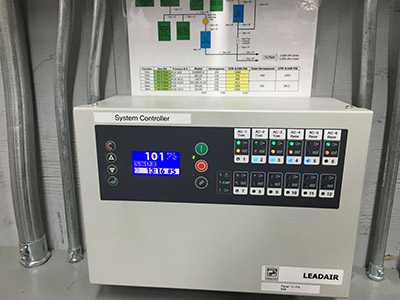
Fig. 1. Look for a compressor controller with smart features that will swap the appropriate sized compressors in and out to match the compressed air flow.

An automotive parts manufacturer wants to better control the air compressors.  They installed a system of permanent monitoring and discovered the following (a quote from the Maintenance Engineer) “You should see what the datalogging revealed … 73% of the time, the system was operating over 30kW/100cfm.  For only 5% of the time below 25 kW.  In that 73% time, the average was realistically at least 40 kW/100 cfm. Ouch!!!”

This company should be commended for actually measuring their system, very few do this.  Once this efficiency problem is discovered, a strategy needs to be created to solve the poor efficiency problem.  This system has three fixed speed compressors  (1 x 150 hp and 2 x 100 hp) that are locally controlled, with poorly cascaded pressure switches combined with inlet modulation control (the least efficient way to control compressors).

The company would like to add a variable speed drive compressor. However, to avoid control gap, they need a 200-hp compressor (sizing rule states the VSD variable range must be equal to or larger than the capacity of the biggest fixed speed compressor).  If they install this large VSD compressor, they have discovered it will run at minimum speed during light loads (evenings and weekends).  Operation of VSD compressors at below minimum speed should be avoided.

They looked to a compressor sequencing control to solve their problem. Fortunately, many controllers are now available that have a type of internal control that will detect low system flow and swap in a smaller compressor to match the load should there be one available. Rather than using cascaded controls where the compressors operate in a set sequence order, implementing smart compressor control will provide much better flexibility and maximum savings.


You may also like:


  • A look at air compressor capacity control problems

  • VMAC releases original research on air compressor lifespan
  • AdobeStock_230123945-beverage-production
    How to improve compressed air systems

Filed Under: Air Preparation

Primary Sidebar

Fluid Power World Digital Edition

Fluid Power World Digital EditionBrowse the most current issue of Fluid Power World and back issues in an easy to use high quality format. Bookmark, share and interact with the leading design engineering magazine today.

RSS Featured White Papers

  • eBook: Practical Guide to Pneumatics
  • Saving energy and service cost with electric linear systems
  • White Paper-How to Design Efficient Pneumatic Systems!

Fluid Power Design Guides

fluid
“pt
EXPAND YOUR KNOWLEDGE AND STAY CONNECTED
Get the latest info on technologies, tools and strategies for Fluid Power Professionals.
Hose Assembly Tips

Footer

Pneumatic Tips

Fluid Power World Network

  • Fluid Power World
  • Hose Assembly Tips
  • Mobile Hydraulic Tips
  • Sealing and Contamination Tips
  • Fluid Power Distributor Lookup

PNEUMATIC TIPS

  • Subscribe to our newsletter
  • Advertise with us
  • Contact us
  • About us

Copyright © 2025 · WTWH Media LLC and its licensors. All rights reserved.
The material on this site may not be reproduced, distributed, transmitted, cached or otherwise used, except with the prior written permission of WTWH Media.

Privacy Policy