• Skip to primary navigation
  • Skip to main content
  • Skip to primary sidebar
  • Skip to footer
  • Advertise
  • Subscribe

Pneumatic Tips

Tips, Trends, Resources, News and Information

  • Blog
  • Industry News
  • Air Preparation
  • Engineering Basics
  • Components
    • Actuators
    • Cylinders
    • Fittings
    • Gears
    • Grippers
    • Pumps
    • Air Compressors
    • Tubing
    • Vacuums
    • Valves
  • Pressure Sensing
  • Design Guide Library
  • Classrooms
    • Pneumatics Classroom
You are here: Home / Air Preparation / Compressed air fail: The spare dryer

Compressed air fail: The spare dryer

August 4, 2020 By Paul Heney

Share

By Ron Marshall

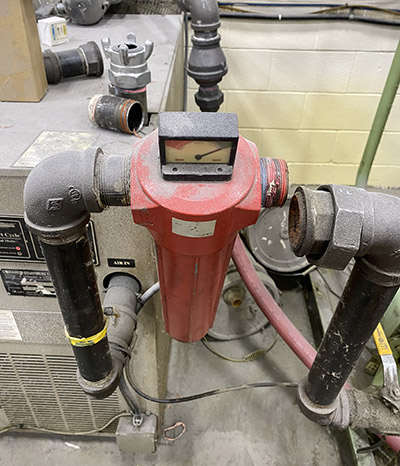
This spare refrigerated dryer was not even hooked up, yet its refrigeration circuit continues to consume power.

A printing plant had two compressors — one main and one backup — each with refrigerated air dryers. A third air dryer was on site as a backup, should the main dryer go down for any reason. The spare compressor was too small for the plant but was used as emergency backup, in case the main compressor would fail.

An air auditor viewed the installation with the goal of reducing the system energy consumption. The auditor typically would measure the kW of each component to ensure things were working as they should. When he measured the air dryer, he was surprised to see the unit was consuming power but was not even hooked up to the compressed air system. The dryer does not have an “off” switch, so it must be deenergized at the disconnect switch.

Air dryers consume much less power than air compressors. In this case, the consumption was only about 1.5 kW, but the operating costs can certainly add up over time. This useless dryer was consuming about $900 per year in electrical costs — while doing absolutely nothing!

The same effect is often seen in other locations when non-cycling air dryers are used as spares or coupled with compressors what are not running (sometimes the offending dryer is inside the compressor enclosure). Non-cycling dryers usually consume near rated kW if left running, even when there is no compressed air flowing through them.

The key to avoiding this kind of energy waste is to turn the spare dryer off when not being used — and to purchase cycling air dryers for any situation where the dryer will not be processing air full time or will be partially loaded. Save yourself some money by attending to your air dryers!


You may also like:


  • Compressed air fail: Dryer clog

  • Compressed air fail: Locked on

  • Compressed air fail: Dryer dewpoint controls

  • Compressed air fail: Oversizing was not the answer

Filed Under: Air Preparation, Featured

Primary Sidebar

Fluid Power World Digital Edition

Fluid Power World Digital EditionBrowse the most current issue of Fluid Power World and back issues in an easy to use high quality format. Bookmark, share and interact with the leading design engineering magazine today.

RSS Featured White Papers

  • eBook: Practical Guide to Pneumatics
  • Saving energy and service cost with electric linear systems
  • White Paper-How to Design Efficient Pneumatic Systems!

Fluid Power Design Guides

fluid
“pt
EXPAND YOUR KNOWLEDGE AND STAY CONNECTED
Get the latest info on technologies, tools and strategies for Fluid Power Professionals.
Hose Assembly Tips

Footer

Pneumatic Tips

Fluid Power World Network

  • Fluid Power World
  • Hose Assembly Tips
  • Mobile Hydraulic Tips
  • Sealing and Contamination Tips
  • Fluid Power Distributor Lookup

PNEUMATIC TIPS

  • Subscribe to our newsletter
  • Advertise with us
  • Contact us
  • About us

Copyright © 2025 · WTWH Media LLC and its licensors. All rights reserved.
The material on this site may not be reproduced, distributed, transmitted, cached or otherwise used, except with the prior written permission of WTWH Media.

Privacy Policy