

A compressed air auditor placed data loggers on a single compressor system with a fixed cycle heatless desiccant dryer. The pressure at the compressor discharge and dry storage tank was also measured, along with the compressor input amps.
On examination of the system profile, it was determined the compressor was rapid-cycling due to lower than desired compressor pressure band and a problem with the air dryer. The problem appeared as a telltale signature on the amp and pressure profile that was exactly 5 minutes wide, as seen in Fig. 1.
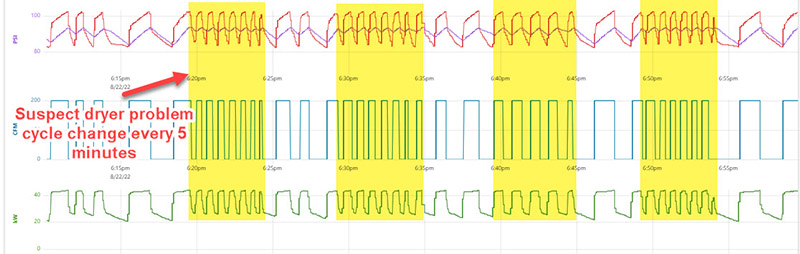
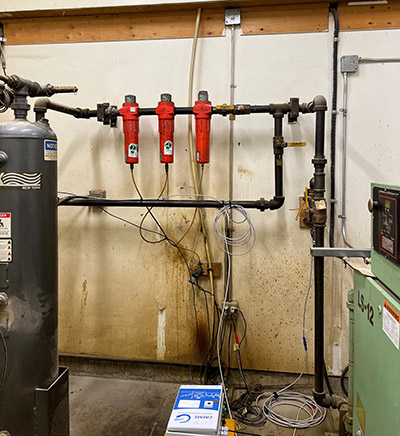 The actual set pressure band on the compressor was 15 psi wide — but due to pressure loss on the filtering, the pressure band when the dryer was purging the right side vessel was only 3 psi wide, and 10 psi wide when the dryer was purging on the left side. This is caused by internal valving problems within the dryer.
When the compressor loads, the discharge pressure immediately jumped up by 12 psi, showing excess pressure differential. This is to be corrected with a redesign of the filtering system.
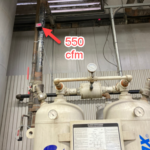
The rapid cycling causes the compressor to consume excess power and have poor power turndown. The power consumption is almost the same when the plant is in full production (150 cfm) or during non-production times (60 cfm). The system consumes about 35 kW per 100 cfm, with system loading averaging 100 cfm with about 40% of the produced flow being the air dryer purge.
It turns out this system does not need desiccant drying, because no part of the system is exposed to low temperatures. No part of the process needs desiccant dried air! Plans are to install proper filters to reduce pressure loss … as well as a correctly sized cycling refrigerated air dryer.


Leave a Reply