• Skip to primary navigation
  • Skip to main content
  • Skip to primary sidebar
  • Skip to footer
  • Advertise
  • Subscribe

Pneumatic Tips

Tips, Trends, Resources, News and Information

  • Blog
  • Industry News
  • Air Preparation
  • Engineering Basics
  • Components
    • Actuators
    • Cylinders
    • Fittings
    • Gears
    • Grippers
    • Pumps
    • Air Compressors
    • Tubing
    • Vacuums
    • Valves
  • Pressure Sensing
  • Design Guide Library
  • Classrooms
    • Pneumatics Classroom
You are here: Home / Air Preparation / Compressed air fail: Drains importance?

Compressed air fail: Drains importance?

September 21, 2022 By Paul Heney

Share

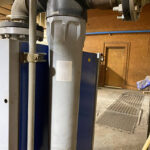
Question: On our air compressor, we have a drain at the bottom of what looks like a filter, located after the air cooler.  The drain failed so we turned it off … how important is it anyway?

Answer: Here is the data you need to know about condensed water flow in compressed air systems (taken from the CAGI Handbook Section 4). On a day when it is 80° F with 60% humidity, every 1000 cubic feet of inlet air contains 0.1210 USG of water vapor. Compressor output of a fully loaded 200 hp is 1,000 cfm, so 60,000 cubic feet per hour.

But the air coming out of compressor discharge, if cooled to 100° F by the aftercooler, can only contain 0.0478 gallons per 1000 of water vapor. The difference is 0.0732 gallons per 1000, so 4.3 gallons per hour of condensed water needs to come out at the compressor water separator drain (that filter looking thing) or about 105 gallons per day.  Turning off the drain will flood the air dryer with excess water.  Dryers are not designed to process free water.

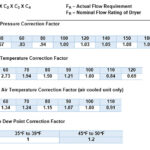
Fig. 1. The attached tables show water intake (1), water vapor volume after the compressor aftercooler (2) and the volume after the dryer (3).  The difference needs to be expelled from condensate drains.

If the dryer is working properly, its output air contains 0.0050 gallons per 1000 at 35° F dewpoint and 100 psi; the difference from the aftercooler is 0.0478 – 0.0050 = 0.0428 gallons per 1000 — or 2.6 gallons per hour, 62 gallons per day. If you are not getting that volume out of the compressor and dryer, then the separator, dryer, and drains are not doing their jobs.

For a quick and easy test, put a graduated bucket under the drains and see the water volume, compare the predicted volume with the CAGI table.

Of course, when it is -40 outside, the water doesn’t even condense in the compressor, so having timer drains blasting as if it is the worst-case day is a waste of power. Hence the need for drains that work on demand.
 

You may also like:


  • Compressed air fail: Cycling dryer savings

  • Compressed air fail: Blowing reduction

  • Compressed air fail: The mystery filter

  • Compressed air fail: Dryer overload

Filed Under: Air Compressors, Air Preparation, Blog

Primary Sidebar

Fluid Power World Digital Edition

Fluid Power World Digital EditionBrowse the most current issue of Fluid Power World and back issues in an easy to use high quality format. Bookmark, share and interact with the leading design engineering magazine today.

RSS Featured White Papers

  • eBook: Practical Guide to Pneumatics
  • Saving energy and service cost with electric linear systems
  • White Paper-How to Design Efficient Pneumatic Systems!

Fluid Power Design Guides

fluid
“pt
EXPAND YOUR KNOWLEDGE AND STAY CONNECTED
Get the latest info on technologies, tools and strategies for Fluid Power Professionals.
Hose Assembly Tips

Footer

Pneumatic Tips

Fluid Power World Network

  • Fluid Power World
  • Hose Assembly Tips
  • Mobile Hydraulic Tips
  • Sealing and Contamination Tips
  • Fluid Power Distributor Lookup

PNEUMATIC TIPS

  • Subscribe to our newsletter
  • Advertise with us
  • Contact us
  • About us

Copyright © 2025 · WTWH Media LLC and its licensors. All rights reserved.
The material on this site may not be reproduced, distributed, transmitted, cached or otherwise used, except with the prior written permission of WTWH Media.

Privacy Policy