

By Ron Marshall
 If you want to keep your compressed air costs down, there are a half-dozen important key principles that you should adopt for your system. Following them will keep your system costs down for the long term and save you a bundle. They are:
1. Install efficient equipment — The most important decision affecting your system efficiency is to buy the right size of equipment to match your load … and to choose a type of air compressor that will operate in a control mode likely to maintain high efficiency through your characteristic load profile. Much has changed over the years with air compressors — you can now put your system on cruise control using variable frequency drives to gain significant savings over other compressor controls. And, if choosing fixed speed compressors for base duty, there are optimized designs now available. Ask your supplier to show you their Compressed Air and Gas Institute data sheets that list their compressor specific power numbers (specific power is like a gas mileage rating for compressors). Use this information to choose wisely. And get a compressed air assessment before you buy that next compressor, so you can size it correctly!
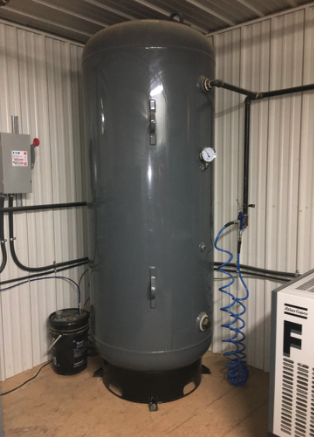
2. Purchase large storage — Almost all compressed air systems can benefit from larger storage receivers. If your main air receiver does not make visitors do a double take when they see it, it is likely too small. Installing between 5 and 10 gallons per cfm rating of the largest trim compressor is a good rule of thumb. And installing secondary receivers downstream where needed to balance fluctuating pressures or service high flow transient loads is a very good idea. Air receivers don’t contain any moving parts and don’t use electricity, but they significantly increase the efficiency of a compressor by simply being there.
3. Dry the air efficiently — There are many choices when it comes to drying of air; the two most common are refrigerated and desiccant drying. The choice of a desiccant type will increase your air drying costs by a factor of at least 3 times. If you want to keep your costs down, don’t over-dry your compressed air. Use refrigerated where appropriate, and purchase more efficient cycling styles that turn down the power consumption with reduction in moisture loading. If you must use desiccant dryers, only dry the portion of the air that needs very low dew points, and purchase the dew point controller option to reduce wasteful purge costs.
4. Keep the pressure low — High pressure in a compressed air system increases the operating costs twofold; the compressors consume more power for every psi increase in air pressure (about 1% more per 2 psi increase) and secondly, the system leaks and unregulated compressed air uses waste more air at higher pressure (about 1% per psi increase). You can minimize this energy waste by keeping your pressure low and ensuring any major pressure losses across air dryers, filters, piping, connectors, and hoses are greatly reduced by proper design, often requiring oversizing. If the pressure at your end use is more than 20 psi lower than the compressor discharge pressure setpoint you likely have a pressure loss problem. Optimum systems have pressure loss of less than 10 psi.
5. Minimize waste — Compressed air is a very expensive way to transfer energy, usually costing about ten times that of a direct drive electrical device, so always be sure the any equipment that consumes compressed air is appropriate — not something that can be better supplied by other energy sources. Major wasters in any system are timer style or manual condensate drains, continuous blowing devices and of course leaks. If you want to cut costs from your system always remain diligent and watch for system waste that can pop up at any time.
6. Monitor your system efficiency — The old saying “you can’t manage what you don’t measure” is true for compressed air. Very few managers can answer the question “how much is your compressed air system costing?” The cost of energy and flow measurement devices has come down a lot over the years, consider installing an efficiency monitoring system on your air compressors to ensure your system is running at reasonable specific power (a level of under 20 kW per 100 cfm produced is excellent) and the leak levels are low (less than 10% of average flow is best practice). To operate without these measuring devices is like operating blind.

This is a helpful article regarding how to keep costs down when running a pneumatic system. I have a related question, not about costs, but about how to conserve the volume of compressed air used.
If one has a small resevoir (i.e. on the field, and not in a large pneumatics), what’s the best way to conserve the volume of compessed air utilised? Is this in the selection of components? If so, what component, should one choose.
Feel free to treat this as a matter of academic discussion.
Best,
Eric Lee
https://britishpneumatics.co.uk/