
• Skip to primary navigation
  • Skip to main content
  • Skip to primary sidebar
  • Skip to footer
  • Advertise
  • Subscribe

Pneumatic Tips

Tips, Trends, Resources, News and Information

  • Blog
  • Industry News
  • Air Preparation
  • Engineering Basics
  • Components
    • Actuators
    • Cylinders
    • Fittings
    • Gears
    • Grippers
    • Pumps
    • Air Compressors
    • Tubing
    • Vacuums
    • Valves
  • Pressure Sensing
  • Design Guide Library
  • Classrooms
    • Pneumatics Classroom
You are here: Home / Engineering Basics / Can electropneumatic regulators be used in hazardous locations?

Can electropneumatic regulators be used in hazardous locations?

August 11, 2022 By Mary Gannon

Share

When thinking of hazardous locations, one’s mind conjures an oil/gas drilling rig, refinery, or underground coal mine — all these locations have in the past utilized traditional pneumatics as risk reduction because they do not have a spark risk, which a solenoid’s electrical actuation requires and creates. Expanding our view of hazardous locations, we should include the gases which are passing through the valves, as those could be combustible, caustic, or generally a hazardous material.   
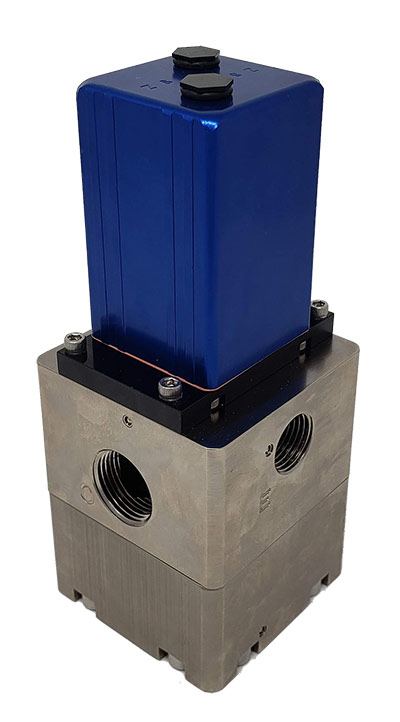
Hazardous locations require products built specifically for them. Propotion-Air’s FM-approved line includes three intrinsically safe devices serving customizable pressure ranges from vacuum up to 150 psig and flows to 200 scfm, and one non-incendive device handling pressures up to 150 psig and flows to 0.80 scfm.

Electronic regulators can be used to control hazardous media directly or indirectly with volume boosters for increased flow rates and speed. A pressure regulator or flow control valve can be designed and built using materials that will provide reliable and safe operations in a hazardous environment or for conveying and controlling a hazardous gas. Like other areas of electrical controls, the solenoids powering the valves have evolved and provide options for safe electropneumatic control of mechanical devices in hazardous locations or control of hazardous gases.

These coils are encased in an enclosure to protect the hazardous location from being exposed to spark, arcs, and dangerous temperatures that could result in combustion. The enclosures are designed to minimize gaps and provide a tight seal to the mechanical components isolating the solenoid from the ambient gas or dusts (such as sawdust and sugar dust which are highly combustible) surrounding it.

These solenoids come specified to meet either mining or the chemical industry flammability expectations.  A common one is the ATEX/IECEx certification from the European Union or the UL Hazloc specification for the United States. Another common approval is FM approval, which is a third-party testing and certification services that tests property loss prevention products and services—for use in commercial and industrial facilities—to verify they meet rigorous loss prevention standards of quality, technical integrity and performance.

The certifications divide the environments into two segments — below ground (typically mining) as Group 1 and surface exposures (gases and dusts) as Group 2. The solenoids are then further refined to the application by the designer through specifying the area classification, protection concepts, gas sub-divisions, and finally temperature classification. 

If using an electropneumatic pressure regulator or flow control in a hazardous location or to control gases, it is reasonable to request a certificate meeting the standards. The solenoid will be marked indicating it is FM, ATEX or UL approved for hazardous locations. With the appropriate solenoids there are very few applications that these valves cannot be utilized.

You may also like:

  • AdobeStock_404081380
    Are electropneumatic controllers suitable for vacuum applications?
  • In bottling lines where the threads and diameters of bottle necks may vary, electropneumatic pressure regulators adjust the pressure output torque of the pneumatic motor to secure the lid on the bottle precisely.
    Can electropneumatic controllers control force, tension, and torque?
  • Keeping your machine shop's air dry and clean is critical for efficient designs. | All images courtesy of Tsunami Compressed Air Solutions
    4 best practices for providing dry air in a job…
  • electropneumatic pressure regulators controllers twist-wire-machine-wohler-zva600-p71110017_4
    Where are electropneumatic pressure regulators/controllers used?
  • Accuracy is often at stake in high pressure applications. Accurate, repeatable pressure control for customizable ranges from vacuum to 1,000 psi direct control in a single unit; assemblies like the GX1 control valve from Proportion-Air offering direct control up to 6,000 psig. Even higher ranges are possible with ratio regulators.
    How do electropneumatic pressure regulators/controllers work?

Filed Under: Air Preparation, Components, Engineering Basics, Regulators, Valves

Primary Sidebar

Fluid Power World Digital Edition

Fluid Power World Digital EditionBrowse the most current issue of Fluid Power World and back issues in an easy to use high quality format. Bookmark, share and interact with the leading design engineering magazine today.

RSS Featured White Papers

  • eBook: Practical Guide to Pneumatics
  • Saving energy and service cost with electric linear systems
  • White Paper-How to Design Efficient Pneumatic Systems!

Fluid Power Design Guides

fluid
“pt
EXPAND YOUR KNOWLEDGE AND STAY CONNECTED
Get the latest info on technologies, tools and strategies for Fluid Power Professionals.
Hose Assembly Tips

Footer

Pneumatic Tips

Fluid Power World Network

  • Fluid Power World
  • Hose Assembly Tips
  • Mobile Hydraulic Tips
  • Sealing and Contamination Tips
  • Fluid Power Distributor Lookup

PNEUMATIC TIPS

  • Subscribe to our newsletter
  • Advertise with us
  • Contact us
  • About us

Copyright © 2026 · WTWH Media LLC and its licensors. All rights reserved.
The material on this site may not be reproduced, distributed, transmitted, cached or otherwise used, except with the prior written permission of WTWH Media.

Privacy Policy