
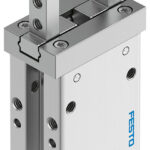
From recently completed production lines, Festo introduces a new generation of competitively priced compact grippers that offer a host of advantages for precision electronics and small part assembly. The DHPC parallel gripper offers ≤ 0.01 mm repetition accuracy, while the DHWC angle and DHRC radial gripper variants offer ≤ 0.2 mm accuracy. The DHPC, DHWC, […]
festo
Lightweight, basic air preparation service units available from Festo

Festo launches MS-Basic, a family of pneumatic service units in polymer housings that offer attractively priced components covering most application needs. MS-Basic air preparation components have the functionality to perform the most important technical tasks necessary for proper compressed air preparation and consist of pressure regulators, filter regulators, electric on/off and soft start valves, as […]
Rid your packaging lines of UKTs (Unnecessary Knob Twisters)

Follow these five steps to prevent tampering and ensure effective and correct process adjustments for pneumatic components. Steve Bain, Industry Segment Manager – Food and Beverage, Festo North America In modern automation systems, the need for frequent process adjustments poses the risk of unwanted device tampering, often referred to in exasperation by plant managers as Unnecessary […]
Festo’s Automation Platform integrates electric and pneumatic motion solutions

With the recent introduction of its distributed I/O solution CPX-AP-A, along with its established CPX-AP-I decentralized I/O, Festo now offers a range of electric and pneumatic automation solutions that is unmatched in North America in terms of performance, flexibility, cost savings, and engineering productivity. AP stands for Automation Platform, and this backplane-based remote I/O system […]
Festo solution for DeltaV DCS allows pilot valve manifold, I/O integration

Festo now offers CPX valve manifold configuration to Emerson DeltaV DCS systems for fast, simple, and effective programming, commissioning, and validation of Festo-based pneumatics for skids and machines. This first-of-its-kind third-party commissioning solution brings one of the world’s most versatile valve manifold control platforms, CPX, to the DeltaV DCS ecosystem. Fast commissioning enables system integrators […]
Festo Didactic’s digital portal allows individualized learning experiences

Digitalization is changing the way people learn, and not just because in-person learning became so difficult with pandemic lockdowns. Trends such as mobile, micro, adaptive, and virtual reality learning were already beginning to exert an influence in technical education and training. To further these and other trends, Festo Didactic developed a digital learning portal – […]
Festo introduces online 3D CAD Configurator for actuators and accessories

Festo continues to enable original equipment manufacturers (OEMs) to lower engineering and purchasing overhead and bring machines to market faster with the company’s new online 3D CAD Configurator for pneumatic actuators and associated accessories such as fittings, lengths of tubing, and sensors. The tool is intuitive and easy to use. Once the actuator is selected […]
Ultra-compact pneumatic cylinder for small movements in tight spaces
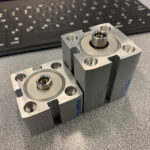
Festo adds a new space-optimized product to its line of pneumatic cylinders ‒ the ultra-compact ADN-S – for performing small movements in tight quarters and, in so doing, helping machine designers keep their projects as space-efficient as possible. Festo took the ISO standard ADN double-acting cylinder and shrank the housing length to create a significantly […]
Designing optimum pneumatic systems for food & beverage packaging

These tips not only adhere to food safety guidelines, but also serve to improve machine utilization and performance. By Steve Bain, Food and Beverage Industry Segment Manager, Festo Before describing the four pneumatic automation design tips for food and beverage packaging applications, it is a good idea to answer a fundamental question: Why apply pneumatic […]
Festo marks 50 years in the U.S. with expansions in U.S.-based manufacturing and R&D

Festo U.S., celebrating its 50th anniversary year, announces expansion plans for its 47-acre campus in Mason, Ohio. A new production facility and the expanded research and development center will be dedicated to U.S.-centric automation components, systems, and solutions. Festo, a $3 billion family-owned company, is a global innovation leader in pneumatic and electric automation systems. […]
