J. W. Winco Offers Pneumatic Power Clamps

May 26, 2010 by  
Filed under Equipment, Gears, Grippers, Industry News

J. W. Winco, Inc. announced it is now offering an additional type of Pneumatic Power Clamps.

JW Winco Pneumatic Power Clamps

The MN 140 series of fastening clamps is a new version of the patented, smaller profile, high clamping force, super-efficient clamps. The two arms on this style of clamp exert an outward force from the center.

The RoHS-compliant, metric size clamps are made of C45 hardened steel with a black oxide finish. They have a maximum pressure of 10 bar and work pressure of 6 bar. As with the other types of Misati power clamps in J.W. Winco’s line, they can be combined with a complete selection of accessories to accommodate any application.

J.W. Winco
www.jwwinco.com

Lenze offers pneumatic clutch

August 18, 2009 by  
Filed under Gears

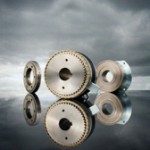
LENZE is offering tooth clutches from Monninghoff, which produces six basic models and variants, covering torques from 100 to 2200Nm.

A clutch with rated torque of 500Nm has an outside diameter of only 166mm, which can be compared with pneumatic friction clutches with diameters typically 100 per cent larger.

Pneumatic tooth clLenze pneumatic Gearsutches can be run in wet or dry conditions and variable toothforms allow adaption to different types of application.  Pneumatic tooth clutches work by applying an air pressure of 4 – 6 bar onto an internal piston.  Very small volumes are required so the response is rapid.  The piston pushes one set of sliding teeth into engagement with a set of fixed teeth; this teeth engagement transmits the torque.  Engagement needs to be at static or low speeds, but disengagement can be at any speed.

The torque-transmitting teeth can be cut in different forms.  Standard is a 20-degree flank angle that suits torque transmissions in either direction.  Saw tooth forms transmit different torques clockwise and counter clockwise.  Irregular toothforms can synchronise input to output at 360 degrees, or at several fixed intervals per revolution if required.  Shallower tooth forms can be used for torque limiting, with the release point being proportional to the pressure applied.

The most popular clutch models have a stationary piston either flange or bearing mounted.  The axial force is transmitted to the teeth by a ball bearing.  The axial movement of the teeth can be detected by using a proximity switch on an integrated switch plate.  This means the clutch state and any overload can be monitored.  Simpler and lower-cost clutches are also available using a rotating union to feed the air supply in through the shaft.  This can halve the length of the clutch.

The Monninghoff range also includes tooth brakes available from 80 to 1000Nm and spring-applied tooth brakes in the same torque range.  Tooth brakes are suited to low-speed applications where accidental engagement will not cause tooth damage.  Spring-applied tooth brakes give a true holding torque until air pressure is applied.

Applications include holding barrier arms, and the toothform can be set so that in an emergency manual force can open the barrier.

Lenze

www.lenze.co.uk