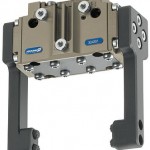
PRG 2-Finger Radial Gripper

April 19, 2010 by Larry Boulden  
Filed under Actuators, Grippers

The new PRG 2-Finger Radial Gripper from SCHUNK combines high gripping moments with small dimensions. The integrated pneumatic oval piston drive guarantees maximum power density.

Radial gripping motions are often achieved by integrating a slotted link gear. Existing links cause an extreme reduction in the gripping moment, if the opening angles are rather small. SCHUNK has found a solution for such an application; the patented Single-Pin guide rail which ensures a constant closing moment throughout the gripping range. The new PRG did not change in dimensions and can reliably grip larger workpieces or workpieces with a larger tolerance range. In addition, innovative dampening, which is directly integrated in the drive rod, allows short cycle times and a much longer admissible finger length.

The multifunctional PRG has an adjustable stroke to fit the individual application and is also available with a gripping force safety device, in a high-temperature version and with three different opening angles (30° / 60° / 90°). The end position can be optionally monitored by inductive proximity switches or magnetic switches.

SCHUNK Inc.

www.schunk.com

Sealed Two-Finger Parallel Gripper

March 25, 2010 by Larry Boulden  
Filed under Actuators, Grippers

The successful DPGplus series of sealed 2-finger parallel grippers has been extended with sizes 240 and 300. The pneumatic drive with oval pistons and the multi-tooth guides ensure precise and reliable gripping. This ensures a high level of machine up time and high returns from production and assembly applications.

The DPGplus sealed 2-finger parallel gripper is an expert at handling rough or dirty workpieces. It is suited for loading and unloading in harsh environments, like grinding machines, lathes, and milling machines. It is also suitable for use in painting systems, powder coating systems, or underwater.

The sealed grippers of the DPG-plus series feature sealing class IP 67 for the highest sealing in its class, with moments between 30 Nm and 160 Nm, (22 Ft-lb-118 Ft-lb) depending on the direction of load and size of the unit and grip forces up to 11,700 N (2,630 lbf). The high sealing class and performance are made possible by combining a multi-tooth guide with a round sealing surface of the base jaws toward the outside.

SCHUNK Inc.

www.schunk.com

.

DUAL SENSOR FOR C-GROOVE CYLINDERS

BIM-UNR Dual Sensor

BIM-UNR Dual Sensor (High-Res)

TURCK’s BIM-UNR line of compact magnetic cylinder position sensors now includes a dual sensor designed for detecting short and long stroke C-groove cylinders. BIM-UNR dual sensors provide a distinct advantage by combining two sensors through one cable connection to speed installation, as well as lessen wire costs and connection points. This design makes the sensor particularly beneficial in areas where multiple cylinders are used, as it only requires a single cable. With dimensions of 2.9 x 4.6 x 18 mm,

Delivering reliable performance and high EMC immunity, thisl sensor provides an exceptional alternative to ordinary cylinder position sensors. The sensor mounts within C-groove cylinders with no accessories required. Plus, it can be inserted into a C-groove from the top rather than from the side, further simplifying installation. On the sensor’s side is a built-in tab that keeps the sensor in place to facilitate one-handed mounting. As the mounting screw is located near the cable exit, the sensor remains fastened even if the cable is pulled.

TURCK

www.turck.us

Hydrogen Hybrid Bus Running On Canadian Streets
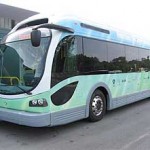

An innovative application for pneumatics helps power a unique  vehicle. The Hydrogen Hybrid Bus (HHB), was built by Golden, CO-based Proterra with funding from the U.S. Federal Transit Administration (FTA) as part of the National Fuel Cell Bus Program, and is managed by the Center for Transportation and the Environment (CTE).

The HHB is operating  on existing bus routes through the Victoria, BC adding hilly, cold weather operations to the ongoing evaluation of the bus. The bus received significant positive exposure by operating throughout the Winter Olympic Games and was featured as part of a formal demonstration and media event on March 11, sponsored by the Southern Hydrogen & Fuel Cell Coalition (SHFCC).

The  bus is powered by lithium titanate batteries and two 16 kw hydrogen fuel cells, producing clean electric power in a lighter, quieter, and more aerodynamic design that is better suited for today’s transportation demands. The  only emission is water vapor. Although the bus was certified for use in the U.S., it successfully underwent additional testing and safety inspections in order to be driven in Canada. With more than twice the energy efficiency of other hybrid buses and four times that of conventional diesel buses, Proterra buses combine tremendous environmental benefits with substantial cost savings to the operator.

Hydrogen Hybrid Bus Details:

  • The HHB is an electric hybrid bus that was purpose built for an electric drive train and can be configured with a wide variety of ‘engines’ or as battery electric only. This version uses clean fuel cells as the ‘engine’.
  • The HHB carries 29 kilograms of hydrogen on board and can achieve up to a 480  km  range.
  • The use of composite materials for the body makes it much lighter – and stronger – than conventional buses.
  • Initial BC Transit evaluation has determined that the fuel economy for this bus in shadow service is approximately 70% better than typical  diesel buses.
  • South Carolina and the University of South Carolina were selected as the primary site for the bus demonstration and evaluation because of their prominence in fuel cell and hydrogen research.
  • The HHB meets Buy America Requirements while utilizing fuel cells provided by Hydrogenics (headquartered in Mississauga, Canada) representing a great US/Canadian partnership for technology development and job creation.

The Hydrogen Hybrid Bus was deployed in August 2009 and is engaged in a two-year demonstration and evaluation project to prove the feasibility of advanced hydrogen-fuel-cell technology applications for mass transit. The demonstration and evaluation project will be conducted in three cities; Columbia, SC, Austin, TX, and Victoria, B.C. Upon completion of the BC Transit demonstration, the bus will return to Columbia to continue its evaluation as part of the University of South Carolina shuttle fleet.